|

(The Hidden
Pearl Vol. I
THE ANCIENT
ARAMAIC HERITAGE
Sebastian P.
Brock
David G.K.
Taylor page 90-91 and 123
With the capture of Nineveh in 612 after a
three-month siege by Babylonian and Median
forces, the center of political power moved
south, to Babylon. The presence of Aramaeans
in what is now south Iraq is recorded as
early as the 11th century BC. At first they
appear just as tribal groups on the
periphery, but in the course of the next
centuries both they and the Chaldeans became
integrated into the settled population of
the region.
It has already been observed that the
importance of the Aramaean presence is still
reflected in the much later Syriac name of
Beth Aramaye
for the area to the east of the
Tigris and south of the river Diyala.
Although the Babylonian king Nabonidus
(555–539 BC) left a lasting impression on
Aramaic literary tradition (see below,
Chapter 8), little in the way of Aramaic
texts from the relatively short period of
the Neo-Babylonian empire survives. From
Babylon itself there are 21 contracts with
endorsements in Aramaic (these mostly
concern taxes on the date harvest), and a
few other very short texts of a similar
nature. Much more dramatic is a small piece
of papyrus from outside the Neo-Babylonian
empire, found at Saqqara in Egypt. This is a
desperate appeal made by a certain king Adon
to his overlord, Pharaoh of Egypt, in the
face of the advancing Babylonian army; this
opens “To the lord of kings, Pharaoh, your
servant Adon, king of …” – and tantalizingly
the place name is lost! Then, after a formal
salutation invoking Baal Shamayin (Lord of
the heavens), Adon goes on to say that “(the
armies) of the king of Babylon have come,
they have reached Aphek” – and then comes
another gap. The text resumes with the plea
that Pharaoh “send an army to rescue me: let
Pharaoh not abandon me”.
The historical context of the letter is
fortunately clear: the letter must refer to
events at the very end of the seventh, or
beginning of the sixth century, when
Nebuchadnezzar II (605–562) made a series of
campaigns in the west against the small
kingdoms of Phoenicia and Palestine
(including, of course, the kingdom of Judah,
whose capital, Jerusalem, Nebuchadnezzar was
to take in 597). Since there are several
places called Aphek, it is not possible to
identify the city state over which Adon
reigned: it may have been Ekron, but Ashdod
or Gaza, or even a Phoenician city, such as
Byblos or Tyre, further north, are also
possible.
In excavations at Nippur (modern Nuffar,
c.180 kilometres south west of Baghdad) at
the end of the nineteenth and beginning of
the twentieth century a large archive of
documents from a family business that was
operating during the second half of the
fifth century was found. Known today as the
Murashu archive, these documents consist of
clay tablets which are for the most part
written in cuneiform, but quite a number of
them also have short Aramaic inscriptions on
them, either written in ink, or lightly
incised; there are also several instances of
seal impressions where the seal stone was
inscribed in Aramaic. Though these texts are
so short, they provide clear evidence that
Aramaic functioned in Babylonia for everyday
business transactions, alongside Akkadian
cuneiform.
The Murashu firm can best be described as
commercial contractors, and the documents
concern such things as agricultural
contracts, irrigation rights, leases, short
term loans, and sale of crops. It is also
interesting to note that out of some 2200
personal names recorded on these tablets,
approximately a quarter are Aramaic ones.
(The Hidden Pearl Vol. I The Aramaic Heritge
– Sebastian Brock & David G.K. Taylor page
123)
Beth Aramaye in Edessan Aramaic (Classical
Syriac) sources
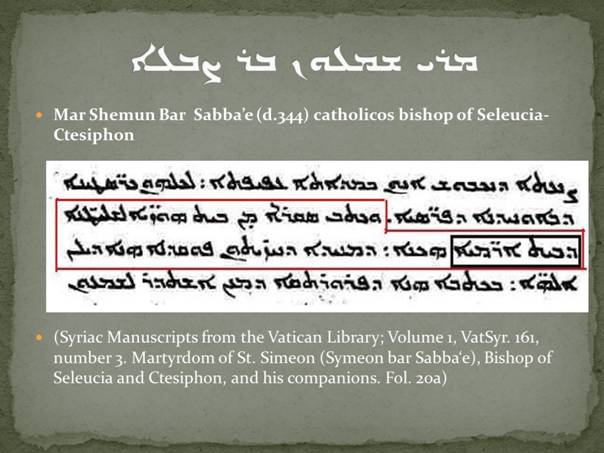
Simon Bar Sabbae († 344), was a bishop and
the second catholicos of Seleucia-Ctesiphon
after Papa. He was killed by King Shapur II.
In the martyrdom of Simon Bar Sabbae and his
companions we read:
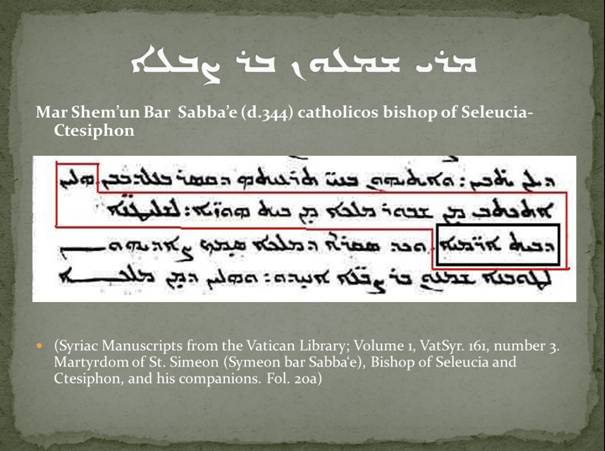
"And from Khuzestan [ancient Elam] he [King
Shapur II] wrote an edict to the rulers of
Beth Aramaye"
"These (things) were written by King Shapur
[II; 309-379 AD] from Khuzestan to the
rulers of
Beth Aramaye."
(Syriac Manuscripts from the Vatican
Library; Volume 1, VatSyr. 161, number 3.
Martyrdom of St. Simeon (Symeon bar
Sabba‘e), Bishop of Seleucia and Ctesiphon,
and his companions. Fol. 20a)
"But that deceiver also came to [the city
of] Mahuze, which belongs to
Beth Aramaye,
and he deceived myriads of Jews."
(ibid, Fol. 23a)
"Then, suddenly, a third edict sent by King
Shapur [II; 309-379 AD] from Khuzestan came
to the rulers of
Beth Aramaye."
(ibid, Fol. 24a)
The historian and Bishop Simeon of Beth
Arsham, which was located near
Seleucia-Ctesiphon, was a famous man who
made disciples and baptised three great and
famous men among the Magians. He passed away
in Constantinople, probably about 532-533.
He says in a letter concerning Barsauma and
the heresies of the Nestorians about Acac,
Catholicos of the Church of the East from
485-495/6 AD :
"Aqaq
the Aramean,
who was called 'the suffocator/oppressor of
farthings' at the very school (of Urhay)"
(Syriac Manuscripts from the Vatican
Library; Volume 1, VatSyr 135, number 6: A
letter by Bishop Simeon of Beth Arsham
concerning Barsauma and the heresies of the
Nestorians. Fol. 25b)
about Mar Benjamin:
"Mar Benjamin the
Aramean,
who later became the abbot of the school in
the village of Daira, which (lies) in the
diocese of our monasteries."
(ibid)
about those 'Nestorians' who were driven
from Roman Urhoy and went to Persia, where
they became bishops:
"Aqaq (in)
Beth Aramaye
and Bar-Sawma the abominable in Nisibin."
(ibid, Fol.26a)
about the Catholicos Babai he writes:
"In the days of Babai the Catholicos, this
Mari emerged (as) the teacher of the
heresies of the followers of Paul of
Samosata and Diodorus [of Tarsus] in
Beth Aramaye.
And Babai the Catholicos, the son of Hormizd
who was the secretary of Zabercan the
Marzban of
Beth Aramaye,
received the doctrine from him. Anyone who
does not confess that Mary is Theotokos, let
him be anathema!"
(ibid, Fol.27a)
The supposed 6th century Chronicle of
Arbela, the work of a writer named
Meshihâ-zkhâ, forms a series of biographies
of twenty bishops who controlled the church
of Adiabene until the 6th century.
VIII. Bishop Hairan of Arbela (225-258
A.D.):
"Following after ‘Ebed Mešiha was the
blessed Hairan, who was from
Beth Aramaye.
[...] In his time were many wars between the
Romans and Parthians. And an Artabanus112,
the grand king of the Parthians, pushed into
the land of the Romans. And he set ablaze
many cities of
Beth Aramaye.
[...]And in earlier times the Persians
sought to pounce on the throne of the
Parthians, and many times they tested their
power in battle [...]
First they fell on Mesopotamia, on
Beth Aramaye,
on Beth Zabdai and Arzun."
(Sources Syriaques. Vol. 1. Msiha Zkha
(texte et traduction).
Bar-Penkaye (texte) par Mingana, Leipzig,
1907, p. 104-105)
IX. Bishop Šahlupa of Arbela (258-273 A.D.):
"Following Hairan, who is worthy of honor
among the saints, was Šahlupa, zealously
caring and hard-working in fear of God. Also
this holy father was from
Beth Aramaye."
(ibid, p. 109)
X. Bishop Aha d-Abuhi of Arbela (273-291
A.D.):
"And in unanimity they both choose of the
entire people Papa, the
Aramaean,
a smart and wise man."
(ibid, p. 119)
The Chronicle of Séert/Siirt is an
anonymously authored historiographic text
written by the Nestorian Church of the East
in Persia and the Middle East, possibly as
early as the 9th century AD. The text deals
with ecclesiastical, social, and political
issues of the Christian church giving a
history of its leaders and notable members.
XV. - History of Catholicos Babai
"Having been fulfilled, all the fathers
chose an inhabitant of Seleucia, relative of
the astrologer Mousa, and secretary of
Marzban of
Beth Aramaye.
He was called Babai, son of Hormizd."
(Patrologia Orientalis, Tome VII. -
Fascicule 2, Histoire Nestorienne (Chronique
de Séert), Seconde Partie (1), publiée et
traduite par Mgr Addai Scher, Paris 1911,
Published Paris : Firmin-Didot 1950, p. 129)
XXVII. - History of Mar Aba the Great
"He was scribe of Marzban of
Beth Aramaye,
who lived in Radan."
(ibid, p. 154)
Isho'dad was a native of Merv. He bacame
bishop of Haditha [Iraq] and flourished in
the middle of the ninth century. He passed
away in 853. In his book "Commentaries on
the Old Testament" he wrote:
Genesis, XI:
"according to some authors, (the writing)
means
Beth Aramaye,
that is to say Mahouze. "
(ibid, p. 152)
Thomas of Marga, born early in the 9th
century in the region of Salakh to the
north-east of Mosul, was a monk in the
monastery of Beth Abhe and later became
Metropolitan of Beth Garmai. He is author of
the important monastic History “The Book of
Governors”.
Book II. Chapter XXII. - Of the going down
of Rabban Simon to George the Catholicos
"Now when the blessed Mar George the
Patriarch went up from the countries of
Persia and Beth Qatraye, because he had been
absent there a long time, and because
everything concerning him was a joy or a
sorrow to this holy congregation, when all
the holy Elders heard of his coming to the
paternal throne of
Beth Aramaye,
they decided to send suitable men to meet
him and to salute the father of fathers."
(E.A. Wallis Budge, The book of governors:
The Historia Monastica of Thomas, Bishop of
Marga, A.D. 840 Vol.
II, London 1893, p. 219)
Book II. Chapter XXXII. - Of Mar Isho-zkha,
the Syriac, Bishop of Salakh
"This blessed man came from the country of
Beth Aramaye,
and according to what I have learned from
the ancients, he was a monk in this holy
monastery."
(ibid, p. 240)
Book VI. Chapter XV. - Of those Ascetics and
holy men who were to be found in various
places in the days of Rabban Gabriel
"And on the episcopal throne of Salakh there
shone with apostolic light the holy Bishop
Mar Isho-zekha, who came from the country of
Beth Aramaye;"
(ibid, p. 652)
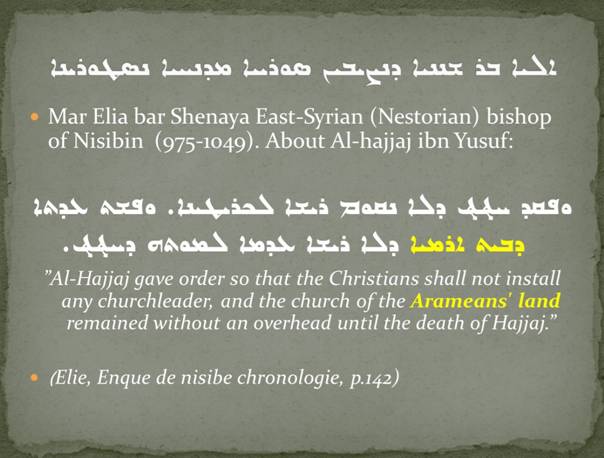
Elia Bar Shenaya of Nisibis, born on
February 11th 975 in the town of Shena, that
is at the confluence of the Tigris and the
Great Zab and passed away in 1049, became
metropolit of Nisibis.
In his Chronography he writes:
"After his death, Heggag, Emir of
Beth Aramaye
gave order that there should not established
any Catholic. The patriarchal throne of
Seleucia remained without a chief for 20
years till Heggag died."
(Chronographie de Mar Élie Bar Šinaya,
Métropolitain de Nisibe, par L.-J. Delaporte
Pubblicazione: Paris : H. Champion, 1910, p.
44))
The year 664:
" In which Mu'awia established Ziad, son of
'Obeia, governor of the
Beth Aramaye
areas."
(ibid, p. 89)
The year 694:
"In which Hegag, son of Jusuf, was
established governor of
Beth Aramaye."
(ibid, p. 94)
The year 695:
"The church of
Beth Aramaye
remained without chief until the death of
Heggag; this means for 18 years."
(ibid, p. 95)
The year 715:
"In which Jezid, son of Muhallab, was
established emir of
Beth Aramaye."
(ibid, p. 99)
The year 720:
"In which Omar, son of Hubeira, became emir
of
Beth Aramaye."
(ibid, p. 100)
The year 724:
"In which Omar, son of Hubeira, was relieved
of the
Beth Aramaye
emirate."
(ibid, p. 101)
The year 745:
"In which he established Omar, son of
Hubeira, governor of
Beth Aramaye."
(ibid, p. 105)
Mar Yahbalaha III, born near Beijing in 1245
and passed away in 1317, was of Uyghur
Turkic descent. The syriac History of
Yahbalaha III and Bar Sauma takes us into
the thirteenth century and records the
adventures of two members of the Church from
China who set out on a pilgrimage to
Jerusalem.
"Though he is denounced to the Harmargerd of
Beth Aramaye"
(Yahbalaha III, Patriarch of the Nestorians,
1245-1317. Tash'ita d-mar(y) Ya(h)b'alaha
w-da-tlata qatulike (') hrane wa-d-had
qashisha w-da-treyn 'almaye nesrturyane
Histoire de Mar-Jabalaha, de trois autres
patriarches, d'un pretre et de deux
laieques, Nestoriens.
(Paris : O. Harrassowitz, 1895), p. 215)
|